
Board of Trustees
2025
OFFICERS

CHAIRMAN
Christopher A. Koetzle
Executive Director, New York Association of Towns

TREASURER
Mike Sweeton
Town of Warwick

SECRETARY
Barbara Van Epps
Executive Director, New York State Conference of Mayors
TRUSTEES
James Bach, Town of Aurora
Edward Brancati Jr., Village/Town of Mount Kisco
Janet Plarr, Village of Blasdell
Hal McCabe, Village of Homer
Andrea Nilon, Town of Hamptonburgh
Mark Blask, Village of Frankfort
Robert Kirkham Jr., Town of Glenville
Lori Mithen-Demasi, Chief Counsel, New York Association of Towns
Kim Splain, Chief Fiscal Officer, New York Association of Towns
Paul Whorrall, Village of Manlius
Additional Information:
This annual report is designed to provide a general overview of the Comp Alliance’s activities and financial condition for those interested. Questions concerning any of the information provided in this report or requests for additional information should be directed to:
Michael Kenneally
Executive Director
New York State Municipal Workers’ Compensation Alliance
150 State Street, Suite 203
Albany, New York 12207
518-210-3352
mkenneally@nycompalliance.org
About the Comp Alliance
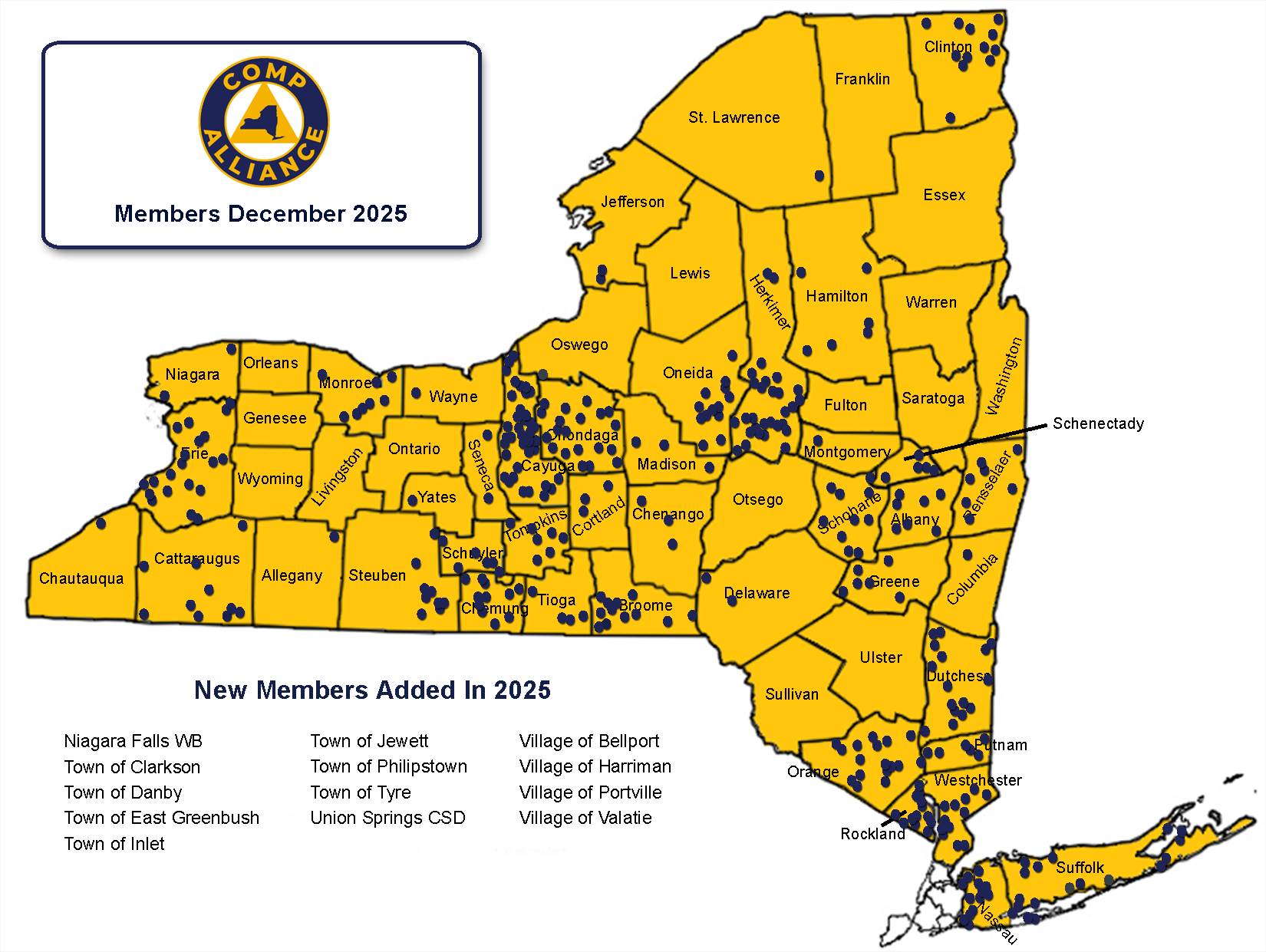
The Comp Alliance is a workers’ compensation group self-insurance program – a network of municipal employers that have joined and contractually agreed to assume the workers’ compensation liabilities of each associated member. By participating in the Comp Alliance, a municipality pools its resources with other municipalities in New York State to obtain workers’ compensation coverage for employees.
The Comp Alliance is governed by a Board of Trustees that includes representatives from its members and two statewide local government associations, the New York Association of Towns (NYAOT) and the New York State Conference of Mayors (NYCOM). The Board of Trustees is responsible for the overall governance, administration and oversight of the Comp Alliance, and is responsible for establishing rates, entering contracts, overseeing all investments, maintaining all bank accounts and oversight of the management company.
Since 2014, the Board of Directors has appointed an Executive Director to perform the day-to-day activities on behalf of the Board. The Executive Director works directly for the Board of Trustees and is responsible for implementing the policies and decisions made by the Board of Trustees. This includes oversight of all contractual relationships of the Comp Alliance, including the management company, actuary, investment manager, auditor, excess broker and excess insurer. In addition, the Executive Director regularly interacts with members to address their questions and promote the Comp Alliance.
Management of the Comp Alliance is contractually provided by Wright Risk Management (WRM). The management contract requires WRM to provide overall program management services such as claims administration, accounting, underwriting, risk management and marketing of the Comp Alliance.
Message from the Chairman
Christopher A. Koetzle
Dear Members and Partners,
On behalf of the Board of Trustees of the New York State Comp Alliance, I am proud to reflect on the strength and success of a partnership that continues to deliver meaningful results for local governments across New York State.
The Comp Alliance was founded through the vision and leadership of the New York State Association of Towns (NYAOT) more than 30 years ago. Throughout that time, NYAOT has remained a key partner in the governance and direction of the program. Our organizations work side by side every day—communicating, coordinating initiatives, and collaborating across multiple levels of leadership and operations. This close and constant collaboration reflects what we believe to be a true partnership in every sense of the word.
In 2014, this partnership was bolstered by the support of the New York Conference of Mayors (NYCOM), who similarly partners in the governance and helps shape the direction of the Comp Alliance. Together, we are guided by a shared commitment: supporting local governments, schools and public entities throughout New York. The Comp Alliance exists for its members, by its members. That principle continues to guide our decisions and our priorities.
The results of this shared services model speak for themselves. Today, 375 local government, school, and public entity members participate in the New York State Comp Alliance. Through the collective strength of our membership, each participant benefits from improved safety programs, risk management resources, and the financial advantages that come from working together.
In 2025 alone, more than $2 million will be returned directly to our members through our Safety Awards Program. Since 2020, more than $12 million has been returned to participating local governments—resources that help strengthen municipal operations and ultimately benefit taxpayers across our communities. We fully expect this trend to continue as the program grows and prospers.
Our financial foundation also remains exceptionally strong. In the past year, the Comp Alliance added $5 million to its surplus, reinforcing the long-term stability of the program and ensuring that we remain well positioned to support our members for many years to come.
These accomplishments are not accidental. They are the result of thoughtful governance, strong partnerships, and the dedication of local leaders who believe in the power of collaboration.
The Board of Trustees remains deeply committed to this mission. We are grateful to NYAOT and NYCOM for their continued partnership and leadership, and we thank our members for the trust they place in the Comp Alliance.
Working together, we will continue to strengthen public employers across New York State.
Sincerely,
Message from the Executive Director
Michael Kenneally, Executive Director
The safety of our workers and the financial health of our program are not competing priorities — they are inseparable pillars of our shared mission. Our promise to you is simple: we will continue to advocate fiercely for the health and safety of your workforce, manage your premiums with the care and discipline they deserve, and be a trusted, transparent partner in everything we do.
As we look back on 2025, it becomes clear how these two pillars support our members and their efforts to maintain a healthy, safe and productive workforce. The Comp Alliance is built to meet both needs and provide increasing value and benefit for our members over time. Your individual commitment to providing safe workplaces for your employees creates stable and secure funding contributions and lower costs over the long term.
Our strong commitment to workplace safety is essential to our success. Every workplace accident prevented not only protects your employees and communities but also reinforces a culture of accountability, preparedness, and care. By continuing to invest in training, risk management, and proactive safety initiatives, we help you reduce exposure, improve outcomes, and ensure that you can carry out essential public services with confidence.
As the risk management landscape continues to change, the Comp Alliance adapts to the needs of its members. Claims related to legalized marijuana and psychological (stress) injuries were not high on our radar when we began. Nevertheless, recent changes in law have placed an increased emphasis on psychological injuries and changes to how stress claims are handled, while the legalization of adult-use cannabis has required municipal employers to be trained on how to recognize impairment on the job and prevent impairment-related injuries. In FY2025, we devoted resources to helping our members understand the liability that attaches to work-related stress and train them on reasonable suspicion of drug and alcohol use. As we enter 2026, we will continue to support and strengthen our initiatives to help you minimize the frequency and severity of workplace accidents and keep your workforce healthy and safe.
Your commitment to improve safety and control of workers’ compensation claims translates to greater budgetary stability. The monetary savings resulting from the safety and well-being of our members are evident throughout this annual report. The strength of this program belongs to all of us — and together, we will continue to build on it.
It is perhaps most evident in our award programs, which allow them to share in the success of the Comp Alliance. In 2025, we returned more than $2 million in funds to our members, and more than $14 million since 2020. By recognizing (and rewarding!) your long-term dedication to keeping your workforce safe, we prove the simple point that a commitment to maintaining a safe workplace will reap the benefits over the long term. The most important return-on-investment, however, cannot so easily be quantified – it is the cost of the accidents that do not occur, and the employees who return home safely from work every day.
Financial Report
Fiscal Year 2025 marked the 30th Anniversary of the Comp Alliance. In that time, the program evolved from a handful of members pooling their resources to cover their workers’ compensation claims to a sophisticated, full-service workers’ compensation insurance program with 370 members and more than $45 million in annual funding contributions.
Membership in the Comp Alliance continues to grow at a steady pace, with membership primarily consisting of Towns, Villages and Schools. Funding remains stable, as rate decreases for our members largely offsets the increase in revenue from new members added.
Changes were made to the Safe Workplace Award program. The revised program now incorporates a survey component that allows all members to showcase their commitment to workplace safety by providing details on safety initiatives, innovations and efforts that help them contain their losses and can also be shared with our members for implementation in their communities. Ultimately, we expect that the continued emphasis on maintaining safe workplaces will continue to be reflected in our exceptional loss experience.
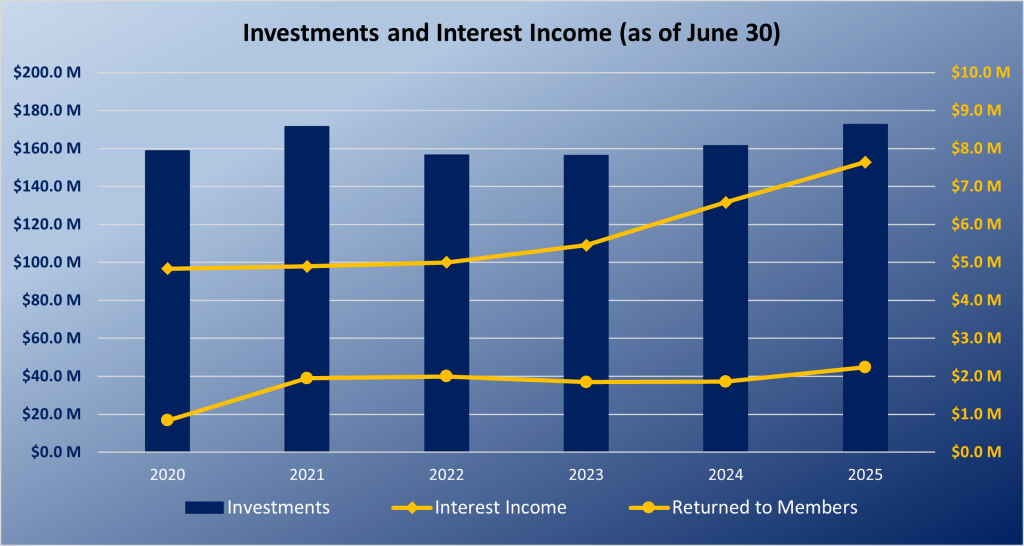
FY2025 saw inflation stabilize at an above average, yet not concerning, level of approximately 3% and fixed income yields remained among the highest that the market has seen in several years.
Short-term rates continued to slowly decline as the Fed reduced borrowing rates and are expected to decline moderately in 2026. Longer-term interest rates are also expected to remain high and continue to offer compelling investment opportunities.
Since the Comp Alliance is a cash positive operation, as new cash flows come in, they can be invested at higher yields and produce more income for the portfolio. The portfolio is positioned to take advantage of the “higher for longer” interest rate environment by focusing on high-quality investments and managing its duration to increase the total return on the portfolio.
For Fiscal Year 2026, the Comp Alliance expects to see continued stability. Backing this expectation are its consistently high member-retention rate, the popularity of its multi-year membership options, the responsible addition of new members, and anticipated rate decreases. The award programs have been extended through the end of FY2026 and are annually evaluated each year by the Finance Committee as part of its Surplus Policy review discussed above. The Finance Committee will meet during FY2026 to examine the financial position of the Comp Alliance and make a determination on the continuation and/or amounts allocated to the award programs for FY2027.
2025 Investment Market Recap
David Wilson, Nuveen Asset Management
2025 Bond Market Recap
The October-November U.S. federal government shutdown has distorted recent economic data. After a pause in economic releases, the latest figures still reflected the effects of delayed and incomplete data collection. At the headline level, inflation improved, with core CPI rising 2.6% year-over-year in November, although this likely understates actual inflation by at least 0.1%. Meanwhile, unemployment ticked up to 4.6%, which probably overstates actual unemployment, again by around 0.1%. Despite these data distortions, both inflation and the labor market remained close to our year-end forecasts.
The Federal Reserve (Fed) cut rates by 25 basis points (bps) in both October and December, as expected. The Bank of England (BoE) also cut rates in December by 25 bps, while the European Central Bank (ECB) kept policy steady. The Bank of Japan (BoJ) diverged from the global trend by hiking rates by 25 bps in December. Overall, developed market central bankers leaned hawkish, with a large minority of BoE governors voting against the cut and Fed policymakers signaling that they will likely pause moving forward, barring major data surprises.
The U.S. Treasury yield curve steepened throughout the year, with the 10-year yield ending at 4.18% and the 2-year ending at 3.47%. Lower rates and tightening credit spreads fueled broadly positive fixed income returns. Emerging markets (EM) debt led the way with a +11.1% total return in 2025, followed by high yield corporates (+8.6%) and commercial mortgage-backed securities (CMBS, +7.7%). The broad Bloomberg U.S. Aggregate Bond Index returned +7.3%. Global bond markets lagged the U.S. aggregate as rates rose across most non-U.S. markets and the U.S. dollar appreciated slightly.
2026 Bond Market Outlook
Entering 2026, we expect U.S. real gross domestic product (GDP) growth to improve. We forecast full-year GDP expansion of +2.0%, modestly higher than 2025’s anticipated pace. With stronger growth, we also expect the labor market to stabilize and unemployment to remain near its current level. On the inflation front, while there may still be some near-term upside from pending tariffs, we ultimately believe core inflation will moderate to around 2.5% by year-end.
As for monetary policy, we project the Fed will slow its pace of rate reductions in 2026 but deliver a total of 50 bps of cuts over the course of the year. That would take the policy rate to a target range of 3.00%-3.25%, near our estimate of “neutral.” In Europe, the ECB will likely remain on hold in the near term before hiking in the second half of 2026. We also foresee the BoJ raising rates at least once more this year.
Our asset allocation continues to modestly favor spread sectors and credit risk, with an up-in-quality bias within asset classes. We think credit spreads will remain volatile in the coming months, which could present more attractive entry points for risk-taking. That said, we already see some attractive opportunities in securitized markets, including CMBS and collateralized loan obligations (CLOs). We also like bonds from certain EM economies poised to benefit from new trade policy. Lastly, we expect Treasury yields to decline modestly and the yield curve to steepen over the course of 2026.
New York Workers’ Compensation Alliance Investment Portfolio Recap and Outlook
The portfolio’s book yield steadily increased throughout 2025, ending at 4.66%, as we continued to re-invest portfolio cash flows at higher yields. On a total return basis, the investment strategy returned +7.52% and outperformed its benchmark, the Bloomberg U.S. Aggregate Index, by 0.22% in 2025. The duration of the portfolio remains modestly shorter than benchmark, and the performance against the benchmark was influenced by an overweight in the spread sectors of the fixed income markets as well as a positive contribution from security selection. Since its inception, the investment strategy has outperformed the benchmark by 0.32% net of fees, on an annualized basis.
Going forward, we remain defensively positioned while favoring the credit spread sectors of the fixed income markets. We expect the yield curve to steepen, as short-term rates will fall more than long-term rates, and credit spreads to be volatile in a low economic growth and unpredictable policy environment. We continue to maintain a high-quality portfolio and a high level of diversification. The portfolio’s book yield should continue to rise modestly throughout the year as cash flows from maturing bonds and new contributions will be invested at higher yields. We expect mid-single digit returns from a diversified portfolio.
Management Report
Wright Risk Management, Program Manager
Management of the Comp Alliance is performed by Wright Risk Management (Program Manager), and is overseen by the Executive Director and three distinct committees of the Board of Trustees, as follows: Underwriting, Member Services (Loss Control and Marketing) and Claims. Each committee of the Board of Trustees establishes the policies, rules and procedures and receives regular reports from the Program Manager. The Executive Director works with each unit of the Program Manager, and coordinates the joint activities of these units, to ensure that the policies and practices put in place are executed seamlessly for the benefit of our members. Below is a summary of the key services for 2025.
Underwriting & Member Services
In 2025, the Comp Alliance grew to more than 370 members and $46M in funding contributions. Our retention rate continues to be strong, with more than 98% of our membership renewing their coverage. Our members continue to take advantage of our multi-year pricing programs, allowing them to “lock” in their cost for up to three years without concern of a payroll audit changing their contribution or a bad year of claims impacting their cost.
We added 13 members to the program, with several being our core, towns and villages, and one new opportunity, the Niagara Falls Water Board. This was a team win, with each department contributing its strengths and the program benefits in an interview with Niagara Falls Water Board leadership.
While we continued to face the inevitable issue of large mod swings due to calculation changes, the Comp Alliance has been persistent in utilizing all available underwriting tools to smooth any major shifts.
The 2022 change in calculation at the state level resulted in a factor that is not always reflective of the member’s exposure and loss history. With the mod being the first factor multiplied against the manual premium, any substantial increase or decrease can drastically alter the starting premium prior to any available credits being applied. The available credits, as written in the underwriting guidelines, are based on the mod factor results. As a result, we have been creative in developing additional procedures, such as the program mod credit, so each renewal mirrors the members’ performance to pass along fair premium proposals.
In 2025, we witnessed mod factors for members increase as much as 93 points and decrease as much as 68 points. The standard variance process and blanket variance for program mod credit procedure were both essential in combating such swings to guarantee fair underwriting results.
Across the 2025 renewal cycles of January, June, and July:
- 13 new members joined the program with nearly $1M in annual premium
- With 184 up for renewal, 102 of those members opted for multi-year policies
- The two-year membership option resulted in $12M in annual premium
- The three-year membership option resulted in nearly $900,000 in annual premium
- 49 members bound coverage early, accounting for $8.1M in annual premium
With the continued strength of the program and over $49M in surplus, the Board’s implementation in 2019 of two award programs has been an ideal use of this surplus. These programs return a portion to members to share in the success and growth of the program, totaling over $11 million to date. The Loyalty Award rewards the member for loyalty to the program and returns funds upon renewal. The Safe Workplace Award acknowledges members who recognize the importance of maintaining a safe workplace and have fewer claims.
Specifically, the Safe Workplace Award compensates members for their performance during the most recently completed full policy period and, with changes made in 2024, now allows each member to provide feedback on the strengths that help them prevent injuries and improve morale for additional rewards. This provided us with insight into how our members view safety and how they rate themselves on workplace safety, training, hazard control, and safety meetings.
In 2025, the Safe Workplace Award program resulted in:
- 78 additional awards based on the completion of the safety questionnaire, earning $316,880 for their practices and procedures.
- 282 members receiving a monetary award totaling $1,109,644 to commend these members on their dedication to safety.
- 252 awards based on evaluation of losses and loss ratio totals for a total of $792,764.
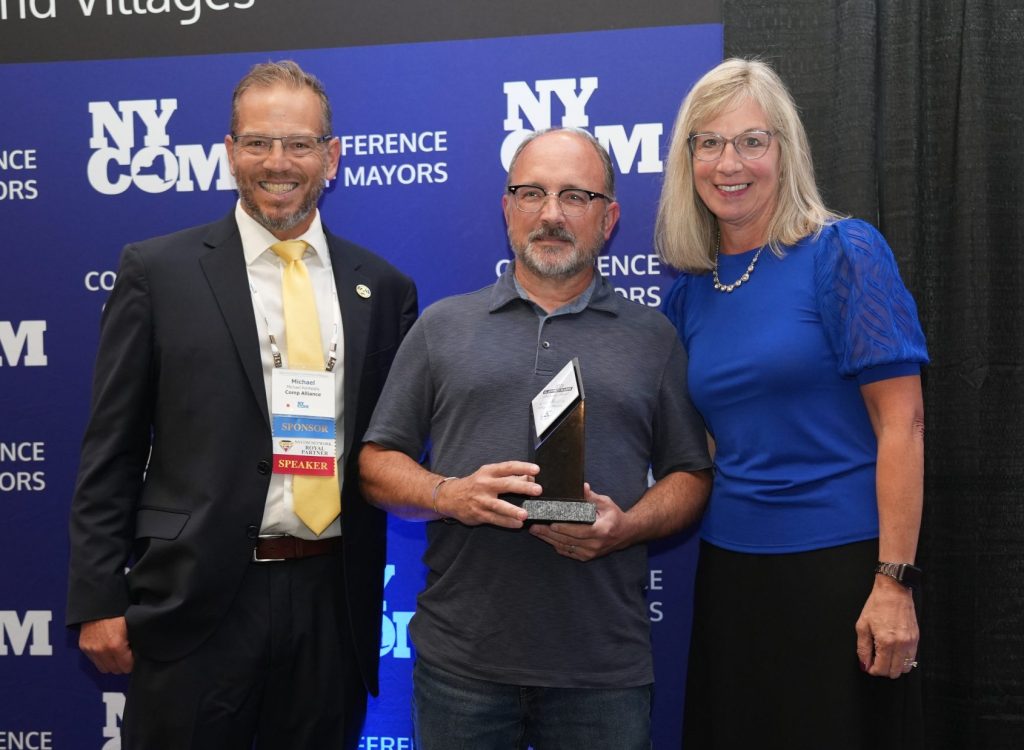
In 2025, we were able to recognize three of our members for their exceptional leadership and accomplishments in providing and maintaining a safe workplace. The Village of Phoenix, Town of Ossining and Town of Irondequoit were recognized for their persistence and commitment to safety and received the G. Jeffrey Haber Leadership Award in 2025. These awards were presented at the NYCOM Fall Training School and the New York State Association of Towns Annual Meeting, respectively.
2025 proved to be another year of growth for Digital Marketing. The Comp Alliance launched a new, sleek, round logo to improve brand awareness while maintaining familiarity. Additional updates were made to the Comp Academy, with new features that improve ease of use and reporting. Along with this, we expanded our online offerings with two new courses: Confined Space Safety and Trenching and Excavation Safety. We launched the new digital format of the annual report, which allowed for the inclusion of video content. Our social media presence continues to grow as we respond to the ever-changing digital landscape, and shared content performs best, reaching a wider audience. We expect this growth to carry into 2026. Members can follow us here for the latest information:
One of the key differentiators of the Comp Alliance is the resources it devotes to keeping public employees safe. Part of injury prevention is awareness. Our risk inspection process and participation in safety committees enable us to share member-specific workplace injury information with leadership, inspect facilities for potential workplace injury hazards, generate recommendations for improvement when applicable, address safety concerns with administration, and review safety practices to best control workplace hazards. A great example is the Lackawanna City School District, where diligent work by our team and buy-in from district administrators led to a significant reduction in claim frequency for the 2024-2025 school year.
New member orientations prove valuable as they strengthen our mission of risk management development from the moment a member joins the program. Consulting visits and claims assistance have been constructive opportunities to remind members of the importance of acknowledging workplace injuries, the significant associated expenses, and the potential improvements to minimize future injuries.
Training remains a mainstay of risk management operations, educating employees on the proper safeguards against workplace injuries and incidents of inappropriate behavior. In 2025, we continued to provide professional, relevant training programs through convenient means. This included weekly virtual training found on the Comp Alliance website, virtual and in-person member-requested training, and regional training sessions. For these programs, training ranged from state-mandated topics of Workplace Violence, Right-to-Know, Bloodborne Pathogens, and HAZWOPER to Lockout/Tagout, Avoiding Slips, Trips and Falls, Personal Protective Equipment (PPE), Trenching and Shoring, Confined Space Entry, Safe Lifting, and Safe Driving.
The department continues to produce safety content in varying formats for members throughout the year. We developed monthly topical safety bulletins, safety tips focused on high-hazard work functions, and quarterly newsletters with school-specific articles.
Moving forward, in 2026 the Risk Management team will continue to provide professional loss control inspections to all our members. One focus is to include brokers more in this process, get them involved in the inspection and the follow-up, and request their participation in safety meetings alongside our risk management personnel. Additionally, we anticipate improving our online resources through a video guide on completing the Safe Workplace Award questionnaire, new and refreshed Comp Academy courses on topics such as School Safety for Special Education Teachers, and articles highlighting members’ positive contributions. Lastly, we will continue to produce year-end and mid-year summaries of police and fire workplace injuries, along with documentation on loss details and best practices for minimizing these risks in the future.
- In 2025, the Comp Academy gained 708 registrants and students completed just over 3,700 courses, a 24% increase from 2024.
- Last year, the risk management department completed 379 inspections, attended 88 safety committee meetings, and 80 orientation, consulting, or claims assistance meetings.
- In 2025, we reviewed nearly 80 applications for the Safe Workplace Award. In addition, we presented 15 times at conferences across the state on varying topics from Managing Stress in the Public Sector to Drug and Alcohol Testing.
- We received 2,439 new claims and closed 1,464 of them before year-end. Also, we processed 50,397 medical billings totaling over $19M in charges, from which we paid only $7M, a savings of $12M.
Claims
Although the above risk management resources and initiatives are intended to prevent workplace accidents in the first instance, unfortunately, the nature of workers’ compensation is that workplace accidents will happen. When an accident occurs, our priority shifts to ensuring the injured employee gets the medical care and attention they need and returns to work as soon as possible. Throughout the claims process, we maintain efforts to support medical needs, replace interim wages, and close out claims for the program’s benefit.
In 2024, the Workers’ Compensation Board (WCB) changed how treating medical providers can submit prior authorization for treatment. There are three levels to this process, with Level 3 being a review from the WCB Medical Director’s Office. In the third quarter of 2025, we expanded our medical services beyond Nurse Case Managers (NCM) to include a Medical Director. Dr. Scott Rankin is responsible for addressing Prior Authorization Requests (PARs) that reach Level 2. With this role and the additional internal service, Level 2 responses can be completed more expeditiously and with cost savings. Dr. Rankin also serves as a resource for both the adjusters and NCM.
As of August 1, 2025, all treating healthcare providers in the workers’ compensation system must submit the CMS-1500 universal billing form electronically through a Board-approved electronic submission partner to be paid for services. The electronic submission mandate does not apply to pharmacies, durable medical equipment (DME) suppliers or hospital billing.
There is a $1 transmission fee per bill, but medical providers can offset the cost of the electronic submission partner by adding a new CPT code to the bill. As the payer, we also incur a $1 transmission fee per bill to receive it. The WCB will not address any bills submitted manually via mail. As a result, we, the payer, can deny payment of services if the CMS-1500 form was not submitted through a Board-approved electronic submission partner, and the Board will not enforce payment. We would need to send an Explanation of Benefits indicating that the bill was not submitted electronically.
We continue to receive paper bills and, therefore, still incur the expense of scanning and processing them with the Explanation of Benefits. This new bill process should improve the timeliness of medical bill submission, reduce the HP-1 (disputed medical bill) process, and avoid the $50 penalty assessed by the WCB.
Our claims team continues to meet the challenges of the program’s growth by identifying injury trends and working with our members to discuss claims. Simultaneously, our claims unit protects the integrity of the program by protecting our members from paying more than necessary on claims. Medical bills are reviewed for compliance with medical billing guidelines, and all claims are reviewed for claims or injuries that are unassociated with the claimant’s employment, or on subsequent injuries unrelated to an initial workplace injury. In 2025, we achieved an average of 13% savings on prescription bills, totaling $62,358, recovered $655,798 in funds through subrogation, third-party liens, and the Second Injury Fund, and achieved 44% savings on radiology procedures like MRIs and EMG studies.
2026 & Beyond
Ultimately, without the continued discussions, approval and assistance from both the Board and the Executive Director, our accomplishments in 2025 would not have been possible. We are appreciative of all their efforts and thank them greatly. For 2026, we will continue to build on the core principles and goals of the program that have led to membership growth, stability and consistency for our members. We remain committed to pursuing additional public entities that are eligible to join the program as of 2024. All entities that join the Comp Alliance can expect superior service, consistent pricing with no payroll audits, multi-year policy options, various safety resources, exceptional loss control services, and award programs that give back.
Our Partners


Throughout 2025, the Comp Alliance made a concerted effort to enhance its performance by leveraging its primary strength: Its relationships with its partners. Our partnerships are the foundation of our success, and the benefits derived therefrom directly impact our members.
The involvement of the Association of Towns of the State of New York (NYAOT) and the New York State Conference of Mayors (NYCOM) as sponsors and in governance of the Comp Alliance ensures that the Comp Alliance will always be in the best position to address the needs of its members. Through their participation in governance, both associations are actively involved in crafting the policies and decisions that drive our success. The application of the knowledge and experience that AOT and NYCOM have acquired is reflected in all aspects of the Comp Alliance’s operations, and our members are well-served by the dedication that these two associations put into our program.
Since its inception, day-to-day operations of the Comp Alliance have been managed by Wright Risk Management, a company with a proven track record of meeting municipal and school insurance needs. Through a dedicated unit of marketing, loss control, underwriting and claims professionals, the Comp Alliance strives to offer superior service to its members.
While NYAOT, NYCOM and Wright Risk Management are the most visible of our partners, they are not only ones. Our excess carrier (Midwest Employers Casualty Company), actuary (Sound Actuarial Consulting), auditors (Mengel, Metzger, Barr & Co. LLP), excess broker (Guy Carpenter) and asset manager (Nuveen Asset Management) all work diligently behind the scenes to make sure members of the Comp Alliance receive the best services and results possible.
Lastly, our long-standing relationships with the agents and brokers with whom we partner on a daily basis is a significant factor to our success. The brokers and agents ensure that the services discussed in this report are made available to all of our members, and that our members’ needs are satisfied promptly.